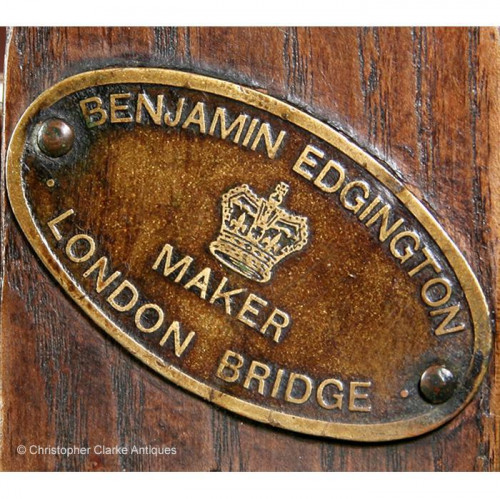
Benjamin Edgington
Benjamin Edgington was primarily a canvas and tent manufacturer whose company operated throughout the greater part of the 19th century. By the turn of 1900 he had joined SW Silver and in many ways it was a natural partnership with both companies bringing strong reputations in similar but different areas of manufacturing and retail. Both sought the military, travellers and sportsmen or clubs as their customers. However, in joint advertising both names were used and they appeared to have kept a degree of independence.
Benjamin Edgington started his business in the early 19th century as a Tarpawling and Sack Cloth Manufacturer in London. It is probable that he was related to Thomas Edgington who is known to have worked on the same street. Indeed, in later years there are a number of Edgingtons recorded as Tent makers suggesting that Thomas started a dynasty. Benjamin's business grew and he soon opened premises in the more fashionable Piccadilly. However, by the second half of the century he had moved to 2 Duke Street, Southwark. His Duke Street premises were large with 5 floors and a very imposing shop front. They are illustrated on his trade card which also shows that he had a mast and rigging set on his roof, presumably as a novel form of advertising. His premises also clearly show a Royal Warrant set over his door. The 1865 London Directory describes his business as 'marquee, tent, rickcloth & flag manufacturer, by special appointment to Her Majesty, marquees & temporary
Benjamin Edgington was primarily a canvas and tent manufacturer whose company operated throughout the greater part of the 19th century. By the turn of 1900 he had joined SW Silver and in many ways it was a natural partnership with both companies bringing strong reputations in similar but different areas of manufacturing and retail. Both sought the military, travellers and sportsmen or clubs as their customers. However, in joint advertising both names were used and they appeared to have kept a degree of independence.
Benjamin Edgington started his business in the early 19th century as a Tarpawling and Sack Cloth Manufacturer in London. It is probable that he was related to Thomas Edgington who is known to have worked on the same street. Indeed, in later years there are a number of Edgingtons recorded as Tent makers suggesting that Thomas started a dynasty. Benjamin's business grew and he soon opened premises in the more fashionable Piccadilly. However, by the second half of the century he had moved to 2 Duke Street, Southwark. His Duke Street premises were large with 5 floors and a very imposing shop front. They are illustrated on his trade card which also shows that he had a mast and rigging set on his roof, presumably as a novel form of advertising. His premises also clearly show a Royal Warrant set over his door. The 1865 London Directory describes his business as 'marquee, tent, rickcloth & flag manufacturer, by special appointment to Her Majesty, marquees & temporary
rooms on hire, lined, boarded, lighted & decorated, suitable for dinners, balls, parties, horticultural shows &c. ; entrance & other awnings, improved dressed cloths, tilts, sacks, ropes, netting &c. 2 Duke street, Southwark SE, foot of London bridge; a stand at the New Corn Exchange, Mark lane ; no other establishment. However, a later address known for Benjamin Edgington is simply 'Tower Bridge SE1' which was found on a flag label. 3 other Edgingtons are also listed separately in the 1865 directory, making and selling very similar wares : Frederick on the Old Kent Road and Thomas Street, John also on the Old Kent Road and Thomas on Long Acre Lane, West Smithfield. It is probable that they all had a family connection and John later advertised that he was the son and successor to Thomas whose business was founded in 1805.
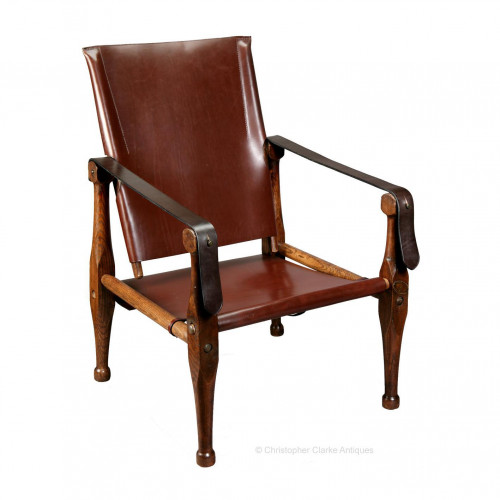
As the Empire expanded in the 19th century Benjamin Edgington's business benefited and he was keen to exploit the value of his goods to those going overseas. In The Globe and Traveller of May 26, 1852 under the heading 'Emigration', Edgington invited 'all who are embarking for the Colonies or the Gold Regions, to inspect his Emigration Tents'. The paper stated that 'a lofty and extensive Warehouse has been added to his premises, where a variety of Tents are erected, so that Settlers and others may select at once the Tent best adapted for their purpose. If you are reading this on a listing by anyone other than Christopher Clarke Antiques, it has been copied without their permission. The Military and Emigration Tents exhibited in Class 8, and for which a Prize Medal was awarded by the Jurors, may also be seen at the above warehouse.' Edgington also realised that he had a strong market in the sports sector. He advertised his 'Alpine Tent' as used on many 'Mountaineering Expeditions' and made sure to note he supplied the most 'eminent Travellers, Explorers, Missionaries and Sportsmen'. He also advertised in Wisden, the Cricket Almanack, where he listed 'strong and durable' Cricket Tents and Tennis Tents 'of new and tasteful designs'. He also sold 'second hand Bell tents for scoring or dressing' and 'tennis poles and nets' along with 'flags for Cricket and Football Grounds'. It is not known at what date Benjamin started to make campaign furniture or the extent of goods he produced but we can guess that it was in the late 19th century. The Roorkhee chair illustrated (No. 148) dates to circa 1900 but there is very little furniture with his name that has surfaced. To add confusion John Edgington also started to supply camp furniture and equipment alongside his tents during this period with his address now 19 Long Lane, Aldersgate St. The company of Benjamin Edgington prospered well into the 20th century and they were one of the best known tent suppliers.
A number of adverts are known that feature both Edginton and S.W. Silver but the exact nature of their relationship is not known. They were both important businesses in their own right. Perhaps it was simply an alliance with a view to an amalgamation that never happened. In their joint advertising one took prominence over the other dependent on the goods illustrated. If it was a tent it would be Edgington and his address would be used, if furniture then SW Silver with their address. Their adverts do suggest however that they issued a joint catalogue. They marketed their businesses extensively together with regular adverts in The Geographical Journal and numerous testimonies as to their reputations in guide and travel books. Sadly, when exactly this relationship ended is not known but they were still advertising together in 1927. The India Rubber, Gutta Percha, and Telegraph Works & Co. Ltd., which operated as a separate business to SW Silver, was sold to the British Goodrich Rubber Company in 1933. In 1967 Benjamin Edgington Ltd. were involved in a takeover by Thomas Black and Sons (Greenock) Ltd. Blacks shops can still be seen on the High Street in England.
1 ITEM